Go-Jek, the company leading Uber and Grab in
Southeast Asia’s largest market, has bagged a hattrick of deals to
advance its mobile payment strategy.
Indonesia-based Go-Jek revealed it has acquired offline payment
firm Kartuku, payment gateway Midtrans and payment and lending
network Mapan for undisclosed sums. Together, the trio process $5
billion in payment across cards and digital wallets, Go-Jek said.
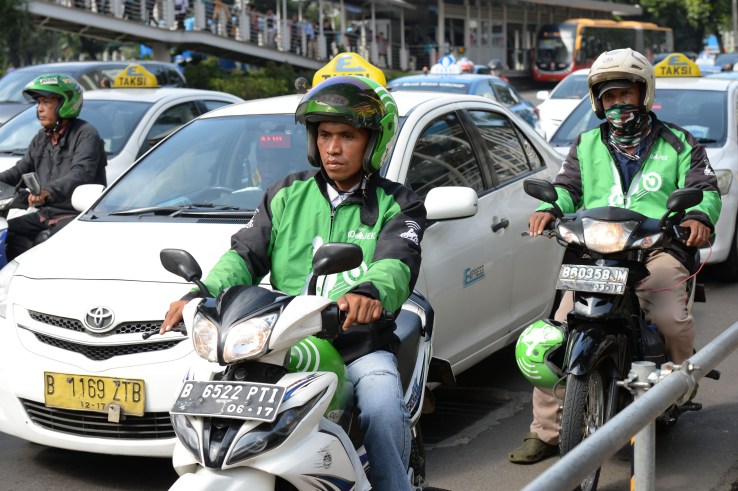
The company started out in 2015 offering a ride-hailing service for
motorbike taxis, a medium of transport popular for getting around
capital city Jakarta’s traffic-clogged streets, but it has since
expanded to four-wheeled transportation, on-demand services and
payments.
Go-Jek claims 900,000 drivers and 15 million weekly active users.
Outside of ride-sharing, it said its business covers 125,000 merchants
with over 100 million transactions processed on its platform per month.
The company is close to raising upwards of $1.2 billion in new funding, which will include money from Chinese duo JD.com and Tencent.
The investment is needed given the capitalization of Uber, the world’s highest-backed private tech company, and Grab, which
recently refueled its tanks with a massive $2 billion round, who are battling over a market that shows promising growth signs.
Ride-sharing in Southeast Asia is projected to become a $20 billion a year business by 2025,
according to a report co-authored by Google,
with Indonesia accounting for upwards of 40 percent. Already, consumer
spending on the taxi apps has more than doubled over the last two years
to cross an estimated $5 billion in 2017.
The goal of the acquisitions — all of which are fellow Indonesian
businesses — is to bolster Go-Jek’s payment network, which centers
around its Go-Pay mobile payment service.
Go-Jek CEO Nadiem Makarim recently told Bloomberg
that his firm plans to expand Go-Pay to cover more retails both online
and offline. The company is seizing the opportunity to offer basic
payment services to cater to the majority of the population in Indonesia
who don’t have access to traditional banking. Credit card penetration
is said to be below five percent in the country, the world’s fourth
most populous nation.
“We are now taking Go-Jek to the next stage,” Makarim said in a
statement. “Through the acquisitions announced today, we will be working
hand in hand with three likeminded companies who share our vision and
ethos. This marks a significant development in our position at the heart
of Indonesia’s vibrant fintech industry.”
The heads of the three acquired companies will take up prominent
roles inside Go-Jek. Kartuku CEO Thomas Husted becomes its
CFO, Mapan’s Aldi Haryopratomo will lead Go-Pay, and Ryu Suliawan of
Midtrans is to head up its merchant platform.
Grab has made moves to emulate Go-Jek. Earlier this year,
the Singapore-headquartered firm set aside $700 million to develop its business in Indonesia, that included R&D budget and capital to buy promising companies. Kudo, an offline payment network,
became its first acquisition.
Like Go-Jek,
Grab expanded its payment service
— GrabPay — to cover offline retailers. Initially that is limited to
Singapore, but the firm plans to expand the feature across Southeast
Asia in 2018. You can bet that Indonesia is top of its list.
Uber recently integrated its first payment wallet in Southeast Asia —
Momo in Vietnam — and
it is now collaborating with taxi operators, but it lacks the medley of services that Go-Jek and Grab offer to consumers in Indonesia.
Featured Image: Dimas Ardian/Getty Images